Singapore Digital Economy Report 2026: what it means for B2B SMEs, and why AI is only the tool
Every year, someone sells Singapore's small business owners a new tool that will change everything. Accounting software. A CRM. An online shop. A chatbot. Now AI.
The tools are real, and many of them work. IMDA's latest numbers show that Singapore SMEs have bought in. Yet if you run a B2B company with 20 or 80 people, you may recognise the feeling behind the statistics: the business has more software than ever, the team is busier than ever, and revenue has not moved the way the demos promised.
That is not a failure of technology. It is what happens when tools arrive before a plan. This guide reads the Singapore Digital Economy Report 2026 from an owner's point of view, explains why AI is a tool rather than a strategy, sets out what changed in Singapore's grants in September 2026 and shows where a growth partner fits.
What does the Singapore Digital Economy Report 2026 say about SMEs?
In short: Singapore SMEs adopted digital tools and AI faster than ever in 2025, but they still use them less deeply than larger firms, and mostly to save time rather than to win business.
The report is published by the Infocomm Media Development Authority (IMDA), the government agency that runs the SMEs Go Digital programme. This fourth edition was released on 5 October 2026. Its enterprise figures describe 2025; its survey of workers was run in 2026.
| Key figure (IMDA, SGDE Report 2026) | 2024 | 2025 |
|---|---|---|
| SMEs using at least one of six digital areas (digital adoption rate) | 95.1% | 96.4% |
| Average digital areas used by SMEs, out of six (larger firms in brackets) | 2.3 (5.0) | 2.5 (5.1) |
| SMEs using AI | 14.5% | 23.4% |
| Larger firms using AI | 62.5% | 70.4% |
| SMEs using cloud computing | 35.9% | 40.9% |
| SMEs using data analytics | 16.5% | 20.1% |
| Digital economy share of Singapore's GDP | 18.8% | 19.3% |
Five findings matter most to an SME owner.
1. SMEs are digital, but they go less deep. IMDA measures six digital areas: cybersecurity, cloud, e-payment, e-commerce, data analytics and AI. In 2025, Singapore SMEs used 2.5 of them on average, against 5.1 for larger firms. IMDA notes this was one of the largest year-on-year gains for SMEs in recent years, but SMEs still use half the toolkit.
2. AI adoption in Singapore is rising fast. AI use among SMEs climbed from 14.5% in 2024 to 23.4% in 2025. Among firms with ten or more employees, Singapore's AI adoption rate of 34.6% is well above the OECD average of 20.3% and among the highest of the countries with 2025 data.
3. AI adoption varies widely by sector. According to IMDA, AI adoption in 2025 ranged from 46.8% in information and communications and 34.5% in professional services down to 18.0% in manufacturing, 15.3% in wholesale trade, 11.4% in transportation and storage and 7.6% in construction. Many of Singapore's B2B companies sit in the lower half of that list.
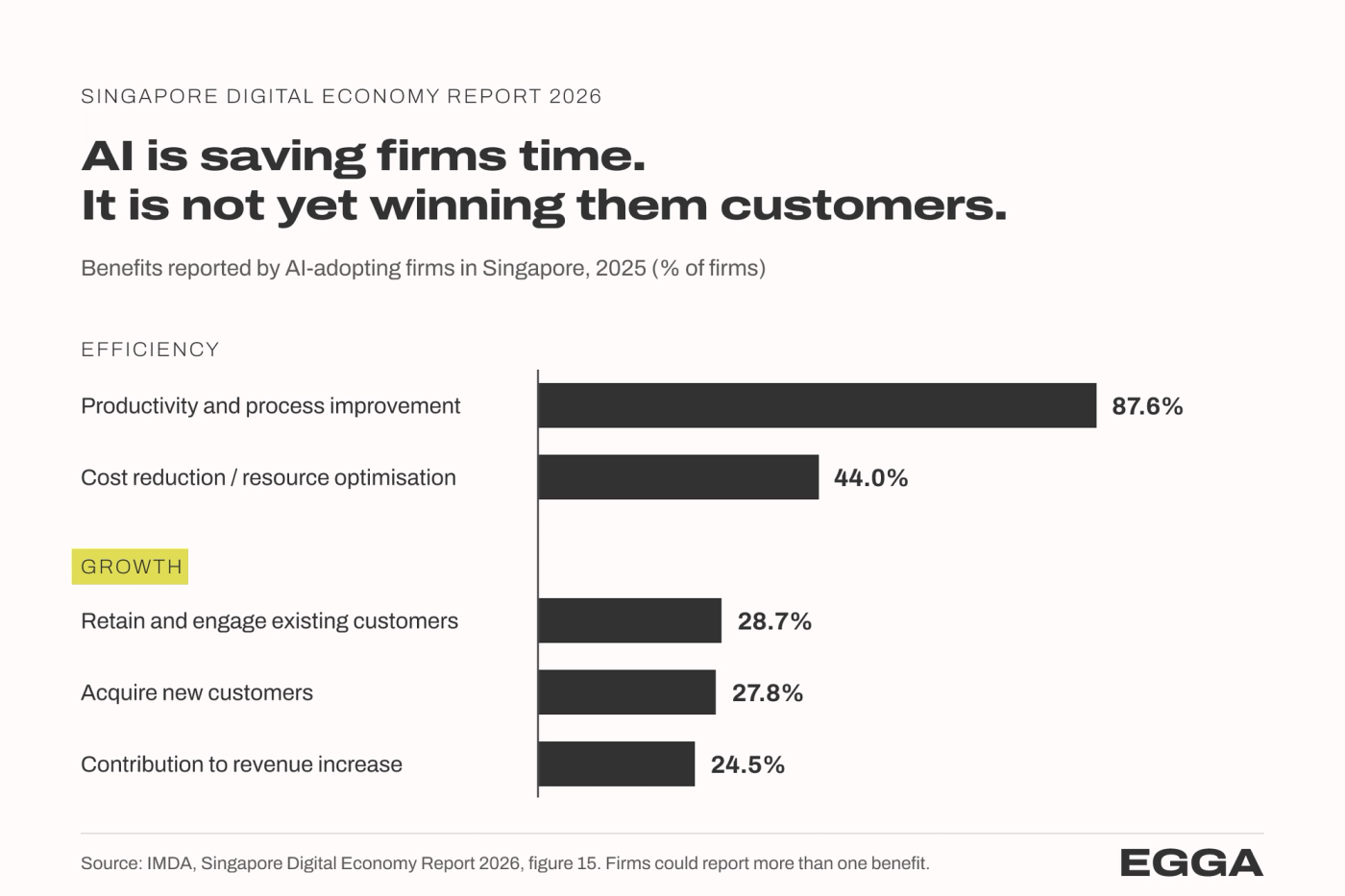
4. The benefits of AI are mostly efficiency. Among AI-adopting firms, IMDA found that 87.6% reported productivity and process improvements and 44.0% reported lower costs. Far fewer reported commercial gains: 28.7% said AI helped them keep and engage existing customers, 27.8% said it helped them win new customers and 24.5% said it contributed to higher revenue.
5. Most AI use is still basic. IMDA reports that 89.6% of AI-adopting firms used off-the-shelf AI tools with no customisation. Employers judged that 47.6% of their workers used AI only for general tasks, and 5.0% could develop or deploy it for complex work. Among firms not using AI at all, the most common reason (54.7%) was that they "do not see the need due to small business".
The report reads as good news, and it is. But read findings 4 and 5 together and a pattern appears. Singapore firms are using AI to do existing work faster. Far fewer are using it to change who they sell to, what they sell or how they win.
Why don't digital tools grow a company on their own?
Because a tool makes a process faster. It does not decide which process deserves to exist, which clients to chase or which market to enter.
Global research reaches the same conclusion. In McKinsey's State of AI 2026 survey of 1,719 executives, 37% of respondents attributed any EBIT impact to AI, unchanged from the year before. Only about 6% qualified as "high performers", seeing significant value and at least 5% of EBIT from AI. McKinsey describes what sets them apart: they pursue growth or innovation alongside efficiency, and nearly three-quarters of them have fundamentally redesigned workflows because of AI, against one-quarter of everyone else.
Boston Consulting Group found something similar in a 2024 survey of 1,000 executives: 74% of companies had yet to show tangible value from AI. The leaders followed what BCG calls the 10-20-70 rule, putting 10% of their effort into algorithms, 20% into technology and data and 70% into people and processes.
Both studies focus mostly on large companies, so treat the numbers as direction rather than a forecast for your business. The direction matches IMDA's Singapore data. The companies that get the most from AI start from a business goal and rebuild the work around it. The tool comes last.
For an SME owner, that is encouraging. You do not need the most advanced AI. You need a clear answer to one question first: what are we trying to grow?
What does a growth strategy look like for a B2B SME?
A B2B growth strategy picks one commercial goal, sets the number that proves it worked and decides the work, in order, that will move that number. Most B2B SMEs we speak to want some mix of four goals. Naming the one that matters most right now is the most valuable decision in this guide.
1. Grow revenue from the clients you already have. Your existing clients already trust you. Selling them a second service, a larger volume or a longer contract is usually the cheapest growth available. AI helps by analysing order history to spot accounts that buy less than their peers, drafting tailored proposals and keeping account reviews on schedule. The strategy decides which accounts are worth the effort.
2. Consolidate the revenue you have. Many Singapore SMEs depend on a handful of large clients. Losing one can undo a year of growth. Consolidating means more recurring work, stronger relationships with the people who sign renewals and a wider base so no single client can sink the year. AI helps by flagging accounts that have gone quiet and by keeping follow-up consistent. It cannot decide which relationships deserve the founder's own time.
3. Win market share. In most B2B markets, the supplier buyers think of first gets the first call. Research by Les Binet and Peter Field for LinkedIn's B2B Institute, based on the IPA effectiveness databank, found that B2B brands whose share of voice exceeds their share of market tend to grow: 10 points of excess share of voice went with about 0.7 points of market share growth a year. AI makes it far cheaper to stay visible, with more content, more campaigns and more languages for the same budget. The strategy decides which buyers you need to be visible to, and with what message. We cover why being known early matters in B2B channel mix after AI search.
4. Open new markets. For a Singapore company, growth often means Malaysia, Indonesia, Vietnam, India or further. Enterprise Singapore's EDGE Grant supports overseas marketing and public relations at up to 70% for SMEs. AI makes translation, local research and adapted content faster. It does not tell you which market to enter first or how your offer must change to win there.
Each goal needs different work, different measures and a different order of priorities. A company chasing all four at once with a new AI subscription usually ends up with busier people and the same revenue.
Where can Singapore SMEs get help with digital tools?
Singapore SMEs have four main public resources for digital tools: IMDA's SMEs Go Digital catalogue, the Go Digital Advisor, sector Industry Digital Plans and Enterprise Singapore's EDGE Grant. Used well, they save real money. Here is who each one suits and where it stops.
| Resource | What it does | Best for | Limits |
|---|---|---|---|
| SMEs Go Digital: Essential Business Solutions | IMDA's catalogue of pre-approved solutions, by business area and by sector | Finding vetted software for HR, accounting, inventory, cybersecurity, CRM and sector tools such as wholesale ERP, freight and warehouse management, or CAD-CAM | A list of software and vendors, not advice on what your business needs most |
| Go Digital Advisor | Matches business pain points to solutions with grant support | Owners who know the problem but not the product category | Matches problems to software, not to strategy |
| Industry Digital Plans | Step-by-step digital roadmaps for specific sectors, aligned with each sector's Industry Transformation Map | Sectors with a plan, including logistics, precision engineering, retail, built environment and food services | Not every B2B sector has a plan, and the plans focus on operations and training |
| EDGE Grant | Enterprise Singapore's single business grant since 30 September 2026 | Funding approved software, equipment, strategy projects and overseas expansion | Up to S$100,000 a year across all activities; paid by reimbursement after completion; at least 30% local ownership required |
What replaced the Productivity Solutions Grant (PSG)?
The EDGE Grant replaced the Productivity Solutions Grant on 30 September 2026. PSG, the Enterprise Development Grant (EDG) and Market Readiness Assistance (MRA) closed to new applications on 29 September 2026, and Enterprise Singapore now runs one grant across eight business areas and more than 150 activities. Ongoing PSG projects continue to be processed and claimed.
Many guides online still describe PSG, so here is what changed for digital tools, according to Enterprise Singapore:
- Pre-approved software now sits under EDGE's single-function digital solutions, at up to 50% support for SMEs and up to 30% for larger firms.
- Caps: support for all automation and digitalisation projects together counts towards an annual cap of S$30,000, within an overall EDGE cap of S$100,000 a year, refreshed every 1 April.
- Eligibility: the business must be registered and operating in Singapore, with at least 30% local ownership, and must not have started work or paid a vendor before applying.
- Applications go through the Business Grants Portal. Third-party companies may not apply for or manage the grant on your behalf, so be wary of anyone who offers to.
Two line items show exactly where software ends and growth work begins.
- CRM: EDGE supports customer relationship management software at up to 50% for SMEs, on a cost capped at S$5,000, so up to S$2,500 of support for up to 12 months of software.
- Digital marketing: EDGE supports digital marketing campaign software at up to 50%, on a cost capped at S$10,000, so up to S$5,000 of support, again for up to 12 months of software.
Both are worth claiming if you need the tool. Neither pays for deciding which leads to chase, writing the follow-up sequence, building the campaign, reading the results or doing it all again next month. A CRM is a filing cabinet for relationships. It does not make the calls.
Do you need software, execution or both?
Before you buy anything, name the bottleneck. This table shows which kind of help each common symptom usually needs.
| What you notice | Likely bottleneck | What usually helps |
|---|---|---|
| Staff spend hours on payroll, invoices, stock counts or rosters | Operations | Software. Start with the Essential Business Solutions catalogue and EDGE funding |
| Enquiries arrive, but nobody can say how many became deals | Tracking | Software first (a CRM), then a simple routine to keep it updated |
| Leads come in, but follow-up depends on who remembers | Follow-up | Both: a CRM, plus a defined sequence someone owns and runs every week |
| The team is busy, but few enquiries come from people you did not already know | Demand | Execution: a clear offer, visibility with the right buyers and campaigns run consistently |
| Prospects visit the website and go quiet | Conversion | Execution: sharper positioning, proof and an easier next step. Try our 30-second positioning test |
| Revenue rests on three or four large clients | Concentration | Strategy and execution: account growth plans, plus new-client acquisition |
| You want to sell overseas but do not know where to start | New markets | Strategy first, then execution; EDGE internationalisation activities may help fund parts of it |
If most of your answers land in the top two rows, the public catalogue and a grant may be all you need. If they land lower down, software will help at the edges, but the work itself is the missing piece. If prospects go quiet on your website, start with our 30-second positioning test.
Who is EGGA, and how does it help Singapore B2B SMEs grow?
EGGA is a growth, sales and marketing service for B2B SMEs, run for you on one fixed monthly fee. It is a Singapore company, operated by Acchalabs Pte. Ltd., and works with owner-led and founder-led businesses that have a real growth opportunity and a decision-maker ready to move. In Singapore, plans start at S$1,200 a month.
Before Singapore, the people behind EGGA spent years doing this work with B2B SMEs in Italy: owner-led companies, often family-run, competing against far larger rivals with far smaller budgets. That experience shaped how we work. B2B SMEs do not need a bigger version of a corporate marketing department. They need someone who understands how their buyers actually choose suppliers, which we write about in how B2B buyers research suppliers and why buyers choose the safe supplier, and who turns that understanding into work every month.
What does EGGA do?
The full list is on how it works. In practice, it covers the four growth goals above:
- Strategy and priorities. Most owners have twelve good ideas and time for two. We help you pick the one that moves revenue most and build the 90-day plan to deliver it.
- Buyer and market research. We ask your clients why they chose you. The answers often change what you sell and who you sell it to.
- Visibility and acquisition. Content, campaigns, search and outreach aimed at the buyers you named, not at everyone.
- Sales support. Proposals, case studies and materials your team actually uses.
- Retention and referrals. Plans to grow the accounts you have and turn their goodwill into introductions.
- New markets. The offer, message and language adapted for the market you want to enter.
- Reporting. Once a month, in plain English: what we did, what it moved and where the next dollar earns the most.
How does a month with EGGA run?
In month one we learn how your business makes money, define your best-fit customer, sharpen the offer and agree the one commercial goal worth chasing. Then we build the 90-day plan. Every piece of work after that faces one test: does it move that number? Deliverables sit on a shared calendar, and we review the numbers with you every month.
AI does much of our research, drafting, analysis and reporting. That is how we deliver this range of work at this price. People decide what matters, what to say and what to stop. It is the 10-20-70 rule from earlier, applied to a small business: the tool is the small part.
How much does EGGA cost compared with hiring a marketing manager?
Growth is not a one-off project. It is work that compounds month after month, so the real question is what you can afford to sustain.
| Option | Monthly cost | What you get |
|---|---|---|
| Marketing manager (median, full-time resident) | About S$11,400: S$10,069 gross wage plus S$1,360 employer CPF | One person with one set of skills, before bonuses, recruitment and tools |
| EGGA Core plan | S$2,000, plus applicable taxes | Strategy, research, content, campaigns, sales materials and monthly reporting, setup included |
| EDGE CRM grant | Up to S$2,500, once | Half the cost of 12 months of CRM software |
The hiring figure comes from the Ministry of Manpower's Occupational Wages 2025 tables: the median gross monthly wage of a full-time resident marketing manager was S$10,069 in June 2025, which excludes the employer's CPF contribution. Employers pay 17% CPF for employees aged 55 and below on wages up to the S$8,000 ordinary wage ceiling. Over a year, that is roughly S$137,000 for one hire, against S$24,000 for a year on EGGA's Core plan.
EGGA's Singapore plans run from S$1,200 to S$3,200 a month, with lower rates on 3- and 6-month prepaid terms. Monthly plans cancel with 30 days' notice, and ad spend stays in your own accounts. Grants are worth claiming for the software, but growth that depends on the next grant round stops when the grant does.
Is EGGA part of SMEs Go Digital or the EDGE Grant?
No. EGGA is not a pre-approved solution under SMEs Go Digital and is not funded through the EDGE Grant. Our pricing does not depend on a subsidy. We are happy to work alongside the software you claim through public schemes, and to help you decide which of it you actually need. For eligibility and approved solutions, always check the official portals.
If you want to see where your own growth is won and lost before you talk to anyone, the free Growth X-Ray takes about 12 minutes and shows results as you answer. If you would rather talk, tell us where the business is and we will set up a free briefing call. More about EGGA in Singapore is on egga.ai/sg.
What should a Singapore B2B owner do first?
Three steps, in this order.
- Pick one commercial goal for the next 90 days. Grow existing accounts, protect revenue, win share or open a market. One. Write down the number that would prove it worked.
- Name the bottleneck between you and that number. Use the table above. Be honest about whether the problem is a missing tool or missing work.
- Match the help to the bottleneck. For operations and tracking, use the official catalogue and claim the EDGE Grant. For demand, conversion and follow-up, find the people, inside or outside, who will run the work every week. Then let AI make that work faster and cheaper.
The order matters more than the tools. Singapore's SMEs have already shown they can adopt technology faster than most of the world. The next step is pointing it at growth.
Questions people also ask
What is the Singapore Digital Economy Report 2026?
It is IMDA's annual analysis of Singapore's digital economy, released on 5 October 2026 and now in its fourth edition. It covers the size of the digital economy (19.3% of GDP in 2025), enterprise digitalisation, AI adoption by firms and workers, and tech jobs and skills. Its enterprise figures describe 2025.
How many Singapore SMEs use AI?
According to IMDA's Singapore Digital Economy Report 2026, 23.4% of SMEs used AI in 2025, up from 14.5% in 2024. Among larger firms the figure was 70.4%. Most AI-adopting firms use off-the-shelf tools without customisation.
Which Singapore sectors use AI the most?
In 2025, information and communications led at 46.8%, followed by professional services (34.5%) and finance and insurance (27.6%), according to IMDA. Construction (7.6%), transportation and storage (11.4%) and wholesale trade (15.3%) had the lowest adoption rates.
Is the Productivity Solutions Grant still available?
No. PSG, the Enterprise Development Grant and Market Readiness Assistance closed to new applications on 29 September 2026. From 30 September 2026, businesses apply for the EDGE Grant through the Business Grants Portal. Ongoing PSG projects continue to be processed.
How much does the EDGE Grant cover for digital solutions?
For pre-approved single-function digital solutions, EDGE covers up to 50% for SMEs, with a cost cap per solution: for example S$5,000 for CRM and S$10,000 for digital marketing software. Support for all automation and digitalisation projects counts towards a S$30,000 annual cap, within an overall cap of S$100,000 a year.
How much does a marketing manager cost in Singapore?
The Ministry of Manpower puts the median gross monthly wage of a full-time resident marketing manager at S$10,069 (June 2025). With the employer's 17% CPF contribution on wages up to S$8,000, the monthly cost is about S$11,400, or roughly S$137,000 a year before bonuses and recruitment.
Can AI replace a marketing or sales team for an SME?
Not on its own. AI speeds up research, writing, analysis and reporting, and IMDA found most firms see productivity gains. But someone still has to decide which clients to pursue, what to say and what to stop doing. McKinsey and BCG research suggests most of AI's value comes from redesigning work around a goal, not from the tool.
Is EGGA part of SMEs Go Digital?
No. EGGA is not a pre-approved solution under SMEs Go Digital and is not funded through the EDGE Grant. It is a fixed-fee growth, sales and marketing service for B2B SMEs, from S$1,200 a month in Singapore.
Sources
- Singapore Digital Economy Report 2026Infocomm Media Development Authority (IMDA), 2026
- EDGE GrantEnterprise Singapore, 2026
- EDGE Grant: Single-function Digital SolutionsEnterprise Singapore, 2026
- EDGE Grant: Customer Relationship Management (CRM)Enterprise Singapore, 2026
- EDGE Grant: Digital MarketingEnterprise Singapore, 2026
- EDGE Grant: Overseas Marketing & Public RelationsEnterprise Singapore, 2026
- SMEs Go Digital: Essential Business SolutionsIMDA, 2026
- SMEs Go Digital: Go Digital AdvisorIMDA, 2026
- Industry Digital PlansIMDA, 2026
- Occupational Wages 2025 (Table 4, all industries, June 2025)Ministry of Manpower, 2026
- How much CPF contributions to payCPF Board, 2026
- What is the Ordinary Wage (OW) ceiling?CPF Board, 2026
- The state of AI in 2026: On the road to ROIMcKinsey & Company, 2026
- AI Adoption in 2024: 74% of Companies Struggle to Achieve and Scale ValueBoston Consulting Group, 2024
- The B2B marketer's guide to the share of voice rule (Binet and Field for the B2B Institute)LinkedIn, 2020